

The Imagined Colossus: Adapting the Constitutional Debate for a Nation of 350 Million
The perils of original intent

Spoiler alert
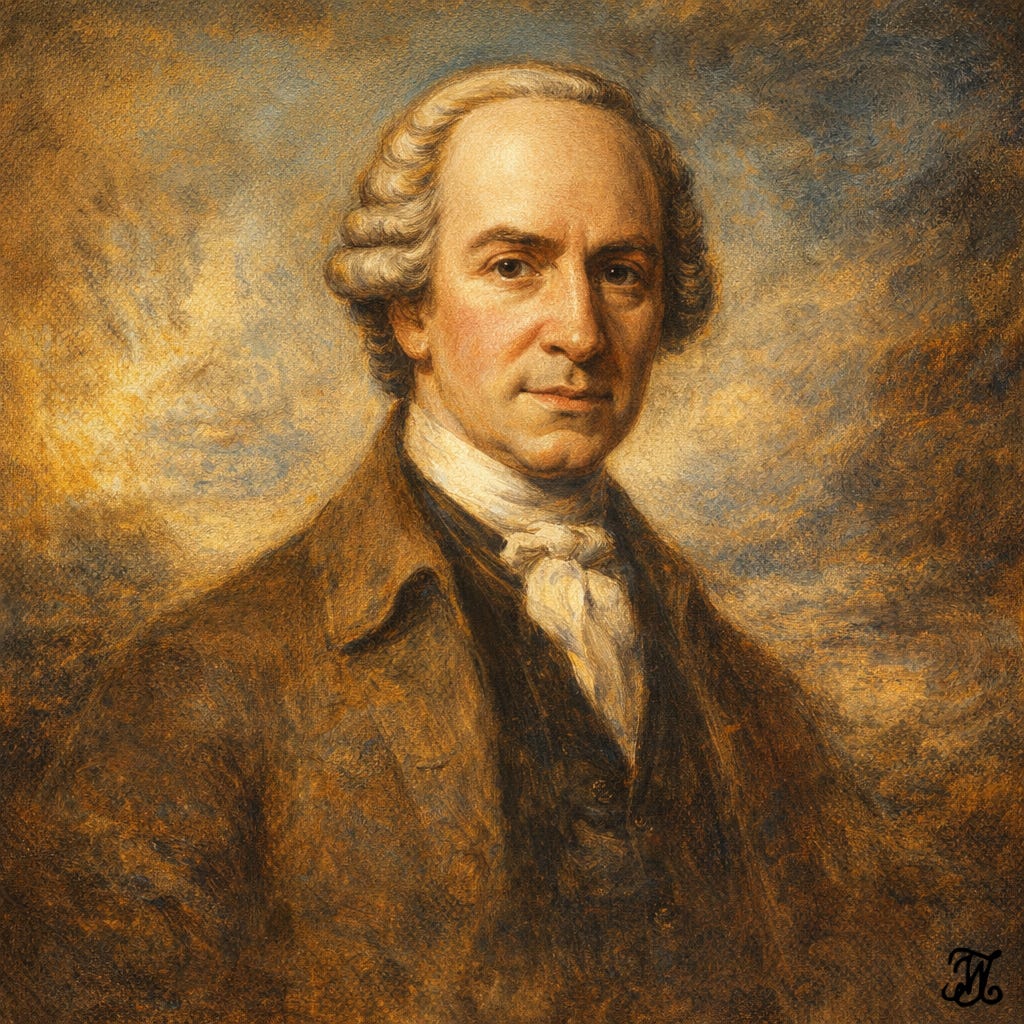
This essay was drafted by Google NotebookLM from a prompt provided by me, and I lightly edited the result, after reviewing the sources cited. The supposed speech by Cassander is entirely my own composition. If that ruins it for you, feel free to rage against the slop, especially if you can find anything better on offer to serve as a contrast.
How Federalists and Anti-Federalists would have reacted to a prophecy of modern America.
This is a speech prepared for the opening of the Constitutional Convention by Rufus Cassander.
My esteemed colleagues, I behold a vision of this fledgling nation that perhaps only Providence can fully foresee. I see not just a union of thirteen states along the eastern seaboard, but a continental nation spanning from eastern shore to western – some distant day. I foresee this land and its people ascending to stand among the foremost powers of the world, with gleaming cities boasting millions of souls. When even a teeming city of one hundred thousand persons shall seem but a country village in comparison.
I foresee the populace of this great land numbering some 350 million free citizens. Thus, we must lay a foundation of laws and governance sturdy enough to bear the weight of so a vast republic. For no longer chiefly shall we be scattered villages where all pray together, work the land together, and know each other by bonds of family or familiarity. But even strangers shall be bound as countrymen in common cause by the ideals enshrined in this Constitution.
So let us attend to this convention with all diligence that we may wield such wisdom and a strong sense unity and national identity as shall steer this fledgling state through whatever tempests may assail our experiment in liberty. Not for this generation alone, but those uncounted generations of Americans to come do we etch the tablets of freedom today. May our vision prove worthy of divine blessing for as long as the Union and this Constitution shall stand.
But Cassander never journeyed from the far reaches of New Hampshire to Philadelphia as he intended for he was felled by a bull and had his skull cracked open.
The Founders had varied views on how long they realistically expected the Constitution to remain in effect before requiring changes or replacement.
Thomas Jefferson
Suggested that constitutions naturally expire every 19 or 20 years and that no generation should bind another. Thought the Constitution should be regularly revised.
Alexander Hamilton
Expected the Constitution to last a considerable duration as part of his arguments for ratification, but was vague on exact timespans. Emphasized importance of flexibility to allow change.
James Madison
Also avoided setting definitive timelines, arguing that regular constitutional conventions could alter the document if needed. Prioritized constant improvement.
State Constitutions
Most state constitutions created after 1776 had clauses calling for revision votes every 5, 7, 15 or 20 years. The Articles of Confederation had been in effect less than 10 years.
Lifespans Mentioned
Some founders referenced historic democracies like Rome or Britain as benchmarks, suggesting constitutions lasting hundreds of years were possible if flexible enough. (Although if the British constitution is dated from the Glorious Revolution it was less than a century old.)
While no specific expiration date was set, most founders expected periodic revision of the Constitution at least every generation or two. They balanced accounting for population growth and new conditions with longevity. But they created an amendable framework, kicking the can down the road in hopes that future adjustments would be made either through amendment or replacement.
What if?
If Rufus Cassander’s imagined speech projecting a nation of 350 million citizens, gleaming cities, and a continental expanse had been delivered at the Constitutional Convention—and validated by the immense influence of Benjamin Franklin—it would have fundamentally altered the framing of the ratification debates. Contemporaries were already deeply concerned about the relationship between population density, geography, and republican government. (Franklin had envisioned the population growing past 100 million in the 19th century and Madison had the population potential twice that in the early 20th.)
Here is how the Federalists and Anti-Federalists might have adapted their arguments for and against the Constitution in light of this astonishing forecast.
The Anti-Federalist Opposition: A Prophecy of Tyranny and Corruption
For the Anti-Federalists Cassander’s vision would have been the ultimate nightmare, validating their deepest fears about the proposed Constitution. They would have seized upon the speech as proof that the new government was destined to become a despotic empire.
The Impossibility of a Vast Republic
Vastness and republicanism cannot co-exist. Anti-Federalist writers like “Brutus” (likely Melancton Smith) already argued that a free republic could not exist over a territory as large as even the original thirteen states, citing the historical failures of the Greek and Roman republics as their borders expanded. Faced with the prospect of a continental nation of 350 million, Brutus would have amplified his argument that true representation would be utterly impossible. He warned that in so large a republic, citizens “will have very little acquaintance with those who may be chosen to represent them,” resulting in a legislature composed of men whose “talents and regard for the public good, they are total strangers to”. Cassander’s admission that the nation would be composed of “strangers” would be lay open the argument that a standing army in peacetime—which the Anti-Federalists vehemently opposed as an evil danger to liberty—would be the only way to enforce laws upon a disconnected, sprawling populace.
The Corruption of “Gleaming Cities”
Cassander’s prediction of “gleaming cities boasting millions of souls” would have appalled thinkers who believed that civic virtue was rooted in agricultural life. Thomas Jefferson, in particular, believed that as long as there were vacant lands, American governments would remain virtuous. However, he explicitly warned against a crowded, urban future: “When they get piled upon one another in large cities, as in Europe, they will become corrupt as in Europe.”
Weaponizing Franklin’s Theories
Because Franklin’s influence hypothetically lends Cassander’s speech credibility, Anti-Federalists would have turned Franklin’s own demographic theories against the plan. Franklin observed that when all land is occupied, those without land must labor for others, leading to low wages and poverty. He also noted that densely packed European cities did not even supply themselves with inhabitants by natural generation because the high cost of living and luxury deterred marriage. Anti-Federalists would argue that adopting a Constitution designed for such a densely packed, European-style dystopian future would destroy the “general happy Mediocrity” of the American middle class.
The Federalist Defense: Institutional Resilience for a “New Order”
Federalists would have adapted their arguments to present the Constitution not just as a fix for the failing Articles of Confederation, but as the only framework capable of surviving Cassander’s staggering future.
Protecting Against the “Excess of Democracy”
Confronted with 350 million “strangers,” Federalists would have leaned heavily into the need to filter popular passions through representative institutions. At the Convention, Elbridge Gerry argued that “the evils we experience flow from the excess of democracy,” warning that the people are often “the dupes of pretended patriots” and “misled into the most baneful measures.” Roger Sherman similarly argued that the people “should have as little to do as may be about the government” because they “lack information and are constantly liable to be misled.”
Fears of a Propertyless Mob
James Madison harbored deep anxieties about overpopulation and later actually forecast a US population of 192 million by 1929. Madison feared this density would bring about the rise of a propertyless class that, in a democracy, might use the government to take wealth from the rich. Taking Cassander’s speech to heart, Madison and his allies would have argued even more fiercely for strong institutional bulwarks to protect property rights against the future passions of teeming majorities. Hamilton was another voice against “the mob.”
The Extended Republic
In Federalist Paper №10 Madison argued that an extended republic helps control factions and self-interest. Under Cassander’s projection, Federalists would likely double down on this, asserting that a populace of 350 million would create such a vast multiplicity of factions that a tyrannical majority would be mathematically impossible.
The Regional Battle: The Atlantic vs. The West
Cassander’s vision of a nation stretching “from eastern shore to western” would have severely escalated regional paranoia during the Convention’s representation debates.
Eastern delegates already feared that “Western people” would eventually gain power and “ruin the Atlantic interests.” Gouverneur Morris of Pennsylvania argued that the “Busy haunts of men not the remote wilderness, was the proper school of political Talents,” and complained that “Back members are always most averse to the best measures.” Cassander’s certainty of western expansion would have prompted eastern Framers to fight harder for constitutional mechanisms to artificially cap western political power, while southern and western delegates would have argued that mandated censuses were absolutely vital to ensure their growing populations received proportional representation.
Conclusion
If Cassander’s speech had been treated as an inevitable truth, the ratification debate would have shifted from a dispute over managing thirteen disparate states to a profound philosophical battle over the destiny of human civilization. Anti-Federalists would have painted the Constitution as a suicide pact that would accelerate the loss of agrarian virtue, creating an unmanageable, corrupt, and tyrannical colossus. Federalists would have countered that only a strong, centralized, and carefully checked national government could possibly prevent 350 million strangers from descending into anarchy or mob rule.
Humanoid coda
Unmediated me (well, except I was only the art director for the illustration)
There is also no evidence that the Congress foresaw the emergence of a “living Constitution,” doctrine under which the Supreme Court would supply suppleness to a governing document that had been over taken by the times. Hamilton approvingly describe the Court as “the least dangerous branch,” and it is likely that no daylight would be visible between the Founders on whether the Court should be saddled with the burden of setting right fundamental questions that the political branches could not. An emphatic no, actually, Hell, no! is the likely consensus position had the question been posed.
And that’s the big fail, right there.

The Constitution was the political solution to the problems of the newly independent Colonies that had tried a loose affiliation and found it wanting. As an immediate fix, it was neither designed nor intended as a permanent solution. While no expiration date label was affixed, neither was a “do not discard” admonition attached. The Civil War was fought not to vindicate a permanence to be found within the words of the Constitution but to enforce the political will of a (somewhat slim) majority to preserve the Union.
The inherent contradiction of the Original Intent doctrine in attempting to attach the original understanding of a narrow political class in the late 18th Century is that it fails to probe the silent assumption that the Framers understood their arrangement necessarily to be as lasting as it proved to be. If they had heard a real-life Rufus Cassander and taken his vision seriously, the only reasonable conclusion would be profound humility.
You have mistaken us for men of unworldly wisdom. We are not able to design a governing regime that will endure centuries. It has never been attempted, let alone accomplished. We will be satisfied that our work, if adopted, will suffice to carry us safely through our infancy as a nation and preserve us from a return of foreign rule. The problems to come, and of course they will come, we must consign to our successors who alone will have the appreciation of the relevant facts and circumstances of which we are necessarily ignorant.
At least one, I suspect, would mutter under his breath “Screw posterity, what have the bastards ever done for me?” as my brother likes to say.
The only founding document worth following is the Declaration of Independence, that is the heart of this nation. The constitution was written latter after the tempers of rebellion had cooled and the founders had too much property they worried about protecting rather than the rights of all of us!
No rage against slop but also no interest. We need a new acronym... Ai;DR?